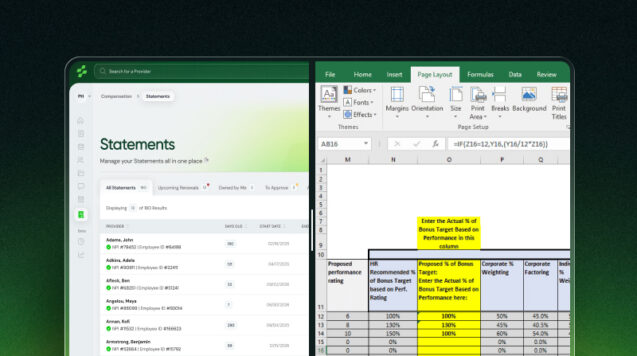


Using Physician Compensation Data to Build Better Compensation Strategies

Physician compensation data exists across EHR systems, spreadsheets, SharePoint folders, and annual benchmark surveys. It’s disconnected, delayed, and invisible to the teams that need it most.
When the compensation director tries to evaluate model performance, audit retention risks, or forecast next year’s physician costs under shifting productivity scenarios, they end up spending weeks manually stitching files together before they can extract a single strategic insight.
The path forward requires moving past raw data collection to focus on how that information is delivered. When compensation data moves from static, rear-view reporting into a connected, real-time asset, health systems can stop reacting to history and start building true compensation strategies.
How compensation data can support better planning
Connected, timely compensation data does more than confirm what physicians were paid last month. When every data point is linked directly to compensation model logic and visible in near real time, it becomes a strategic planning tool.
Workforce planning and recruitment strategy
Workforce planning requires knowing where physician capacity is constrained, where productivity is declining, and what it will realistically cost to fill or stabilize those gaps. That demands a connection between compensation data, payroll data, live productivity trends, and current market benchmarks, rather than relying on a static spreadsheet of FTEs by department.
Recruitment offers are where this gap becomes most visible. A physician compensation survey published in a given year typically reflects data collected 12 to 18 months earlier. By the time that report reaches a recruiter building an offer, the market may have already moved. Offers anchored to stale benchmark data may no longer be competitive by the time the candidate signs, which is a costly way to lose a top search.
Access to continuously updated market benchmarks allows compensation teams to build recruitment offers and workforce plans based on the market physicians are evaluating today. By integrating real-time market data directly alongside internal productivity trends, physician compensation platforms like Simpliphy ensure health systems aren’t pitching last year’s rates to today’s candidates.
Budget forecasting and cost modeling
Accurate budget forecasting depends on knowing what current compensation models will produce across a range of productivity scenarios, not just what they produced last quarter. Organizations running on static monthly reports can reconcile backward with reasonable confidence. Modeling forward is a different problem entirely.
Real forecasting requires live production data connected to compensation model logic. Without that connection, comp teams are working from averages and assumptions rather than running actual numbers through the models that govern physician pay. When productivity shifts mid-year or a plan change goes live, the budget impact should be calculable in advance, not discovered during the next reporting cycle.
Modeling compensation plan changes before they go live
Before a comp committee approves a model change, leadership needs exact line-of-sight into financial exposure and provider impact. Evaluating a plan change requires knowing what it will cost the organization and how it will alter individual physician earnings. That level of precision is difficult without a platform that pairs physician-level production metrics directly with compensation model logic.
Some organizations run dozens of compensation model variants within a single specialty. Estimating the impact of a threshold adjustment or rate change across that population by hand is slow, error-prone, and often produces answers that don’t hold up when the change goes live. Running the numbers through the actual models before anything is approved is the only way to know what a plan change will cost.
Continuous comp model monitoring and optimization
Many health systems design a compensation model change, socialize it, implement it, and then move on. The monitoring phase—measuring whether the change actually produced the intended behavioral and financial outcomes—is the part most organizations skip, usually because they don’t have the infrastructure to do it.
Unmonitored models create strategic blind spots. An incentive designed to expand wRVU production or improve patient access only generates value if leadership can verify that clinical behavior is actually shifting. Timely, aggregated data provides continuous feedback, allowing comp committees to evaluate whether plan changes are driving the target shifts in behavior and financial predictability. Without it, model evaluation defaults to a high-stakes annual review where the only available evidence is what already happened.
Retention planning and early warning signals
Retention risk typically shows up in the data before HR receives a resignation letter, and replacing a physician costs $500,000 to over $1 million. Declining productivity, a widening gap between a physician’s compensation and the current market benchmark, or a model structure that no longer rewards the work being done are all early warning signs that traditional, quarterly aggregate reports bury under department-level averages.
Catching them requires physician-level data that’s current enough to be actionable. A compensation director reviewing a report that’s six weeks old and rolled up by department cannot spot an individual physician drifting toward the door. That visibility requires a different data structure than most organizations currently have in place.
This is where real-time analytics changes how compensation teams approach retention. Rather than spending weeks manually building complex scatterplots and quartile distributions in spreadsheets, platforms like Simpliphy populate these insights instantly. Interactive dashboards that map physician pay against productivity percentiles allow leadership to spot critical outliers in seconds.
Comp teams can quickly identify flight risks where high producers are constrained by poor incentive structures, as well as compensation anomalies where payouts outpace clinical performance. Having instant visual access to these trends enables leaders to intervene and protect key medical group talent long before a resignation notice is served.
Why compensation data systems often fall short
The problem facing health systems is rarely a lack of data. Rather, it is that their data infrastructure was built for rear-view payroll processing rather than proactive strategy, rendering it operationally useless for planning.
Manual reconciliation friction forces reactive strategies
Most organizations are trapped in a cycle of infrequent reconciliations because manual spreadsheet workflows are so labor-intensive that teams can only afford to execute them once or twice a year. Assembling basic monthly reports consumes the compensation team’s entire bandwidth, forcing analysts to deliver rigid, high-level summaries without the operational nuance or deep filtering leadership needs just to meet committee deadlines.
The true drag on ROI occurs when a committee member asks a seemingly simple follow-up question during a meeting. Without connected software, answering that single question forces the compensation director back to square one: spending weeks re-stitching spreadsheets to uncover what should have been an instant answer. Instead of evaluating forward-looking strategies, the team remains perpetually bogged down in administrative catch-up.
Siloed systems create strategic blindspots
Physicians enter production data into the EHR, operations teams track productivity trends, and the compensation team manages contract rules in spreadsheets. None of these systems produces a coherent picture on its own, and in most organizations, the connecting layer between them simply does not exist.
Instead, analysts pull data manually into bridge spreadsheets and upload static reports to internal drives. Evaluating model performance or forecasting future costs forces a compensation director to work across disconnected systems, several workbooks, and a set of high-risk assumptions.
Dispute resolution swallows bandwidth
When physicians cannot connect their clinical work to their compensation figures, suspicion builds. What starts as a minor inquiry about a missing wRVU or an unexpected adjustment can escalate into formal disputes, audits, and costly clawbacks.
When a manual spreadsheet calculation error leads to a major overpayment clawback, repairing physician trust can take years. The resulting influx of disputes adds to the comp team’s workload and presents an even larger opportunity cost. Every hour spent tracing calculation errors and managing damaged relationships is an hour not spent on retention modeling, plan design, or the strategic initiatives the team was built to support.
What makes compensation data actionable
Compensation data should be far more than an input for calculating monthly paychecks. When connected into a coherent system, it becomes a strategic decision engine for comp teams. Five characteristics separate data that supports strategy from data that only supports reporting.
Connected compensation and productivity data
The foundational requirement is a direct, traceable link between the work a physician performs and what appears on their compensation statement. Clinical production and payroll typically live in separate systems without a connecting layer, making it difficult for compensation teams to clearly demonstrate to physicians how their clinical work translates into their pay. That gap is where physician disputes begin and strategic analysis stalls.
When metrics such as wRVUs and panel size connect directly to payout logic, compensation leaders can analyze true cost-per-unit-of-work, evaluate the financial health of specialty lines, and model margin impacts at the physician level rather than the department average.
Connecting these inputs inside a single system also establishes verifiable calculation accuracy. After implementing the Simpliphy platform, Stephen Rabon’s team at ChristianaCare audited every automated calculation and found zero errors. Eliminating manual formula risks creates the reliable data baseline required for every downstream strategic initiative.

Timely information
Connected data is only as useful as the speed at which it can be acted upon. When reporting relies on manual spreadsheet workflows, building a single quarterly update takes weeks of tedious data stitching. When committee members ask follow-up questions, the team burns another several weeks digging back into workbooks to respond. By the time an answer is delivered, the window to act may have closed.
Real-time visibility shifts compensation governance from reactive reporting to active steering. When data flows through an automated system, reports take minutes to generate instead of weeks, and follow-up questions can be answered live in the room. This operational speed gives compensation teams the agility to spot mid-year productivity shifts, flag budget variances, and address market pay divergences while there is still time to intervene.
Consistent calculation logic across models
Spreadsheet-based calculation introduces errors not because analysts are careless, but because workbooks with many tabs, managed across multiple people with no version control, can eventually produce inconsistencies. The question is not whether errors will occur, but how long before they surface and how much trust they cost when they do.
Consistent, automated calculation logic applied across all models is the baseline requirement before any strategic use of the data is possible. When every model runs through the same rules engine, cross-specialty benchmarking becomes reliable, portfolio-wide reporting becomes credible, and comp committee discussions can focus on strategy rather than reconciling conflicting numbers from different sources.
Benchmark context that reflects current market conditions
A physician compensation report or survey has a clear role in comp design and FMV documentation. But survey data collected in one year and published the next cannot support real-time compensation conversations with physicians or drive timely recruitment decisions.
Strategy requires an understanding of internal performance against current external market realities. Pairing live compensation and productivity data with a benchmark that reflects actual market conditions allows comp teams to build competitive recruitment offers and identify retention risks before they become vacancies. The physician salary data a recruiter uses to build an offer should reflect the market the candidate is currently evaluating, not the one that existed when the survey was fielded.
Simpliphy Real-Time Benchmarking provides continuously updated pay and productivity percentiles, allowing your team to analyze specialty-specific trends and build competitive recruitment offers.
Transparency physicians can actually see and verify
Strategic comp model changes only succeed if physicians trust the direction. When a physician can see their production data, understand how it flows through the compensation model, and verify the resulting figure on their own, the volume of disputes drops and confidence in the compensation process improves.
That transparency also functions as a change management tool. When a comp committee redesigns a model to drive different behaviors, such as increased patient access or higher wRVU production, physicians are far more likely to respond to those incentives if they can see the connection between their clinical activity and their earnings in real time. Some organizations have used this level of visibility as a recruitment differentiator, and physicians who have access to it often make clear they would resist losing it. That’s how much physicians value being able to verify the numbers themselves.

Turning data into compensation strategy
Having connected, timely, consistent data is the prerequisite. Using it to run a better compensation operation requires changing some of the workflows that sit on top of it.
Step 1: Unify production data, model logic, and payroll in real time
Replace manually linked workbooks with an automated system that connects EHR clinical production, compensation rules, and payroll data in real time. While pairing production data with model logic calculates what a physician has earned, bringing in payroll data provides true financial reconciliation, automatically subtracting what was paid to surface the exact current balance. This eliminates the manual true-up calculations, data lag, and formula friction that make static monthly reports the ceiling of what is possible.
The immediate operational payoff is fewer disputes: when physicians can see how their clinical work flows through to their compensation statement, the volume of inbound questions drops. The strategic payoff is a clean, reliable baseline that leadership can actually plan from.
Learn more: From Black Box to Clear View: Unifying Physician Compensation and Performance Management
Step 2: Establish dynamic scenario-testing workflows
Shift the comp committee’s process from reviewing what happened to testing what could happen. Before any model change goes to a vote, run it through historical physician-level data to see the actual margin and earnings impacts across the full provider population.
This matters especially for organizations running multiple model variants within a single specialty. Estimating the effect of a threshold adjustment across many model types by hand can produce answers that don’t hold up when the change goes live. Running the actual numbers before anything is approved takes the guesswork out of compensation redesigns.
Step 3: Overlay internal performance metrics against market context
Instead of anchoring recruitment and retention decisions to a static physician salary report that may be a year or more out of date, overlay internal performance metrics against current market benchmarks continuously.
This gives comp teams two capabilities they typically lack: the ability to spot a physician whose compensation is drifting below market before they start a job search, and the ability to build competitive recruitment offers that reflect the current market reality.
Step 4: Transition from annual post-mortems to mid-cycle governance
Year-end reviews can only tell you what went wrong. When you build ongoing review cadences into the compensation operation, budget variances, productivity dips, and model performance gaps surface while there is still room to intervene. A comp model designed to drive a specific behavioral outcome should be evaluated against that outcome continuously, not a year after implementation when the only available response is a redesign.
Move from raw data to decision support with Simpliphy
The core problem most compensation directors face is that the data they have isn’t structured to support the decisions they’re responsible for. Production data, compensation logic, payroll data, and benchmark surveys live in disconnected systems, which means forecasting, retention planning, and model impact analysis all end up running on assumptions rather than numbers.
With a connected data foundation, clinical activity links directly to compensation model logic, physicians can verify their own numbers, and committees can model a plan change before it goes to a vote rather than discovering the cost after it goes live.
Simpliphy is built to be that connecting layer. Production data from the EHR, compensation model logic, payroll data, benchmark context, and physician-facing transparency all run through the same system. Comp teams can trace any statement back to its source, leadership can test scenarios before approving them, and physicians can keep track of their earnings without calling anyone.
If you’re working through how to make your physician compensation data more useful, whether that’s tightening your forecasting, offering competitive salaries to top talent, or getting ahead of retention risks, request a demo to see how Simpliphy connects the pieces in practice.
You may also like:

The Simpliphy Team combines experience in physician compensation, healthcare finance, operations, and technology to help health systems navigate one of their most complex administrative functions. Through practical insights and firsthand experience, our team shares perspectives that help organizations simplify compensation, improve transparency, and make more informed decisions.

Danny McNight is Director of Marketing at Simpliphy, leading the development of campaigns and brand experiences that make complex ideas clear and compelling. With a background in digital creative direction, he helps shape how Simpliphy communicates its value across channels and audiences.