


Why Spreadsheet-Based Physician Compensation Models Break at Scale — and What Replaces Them
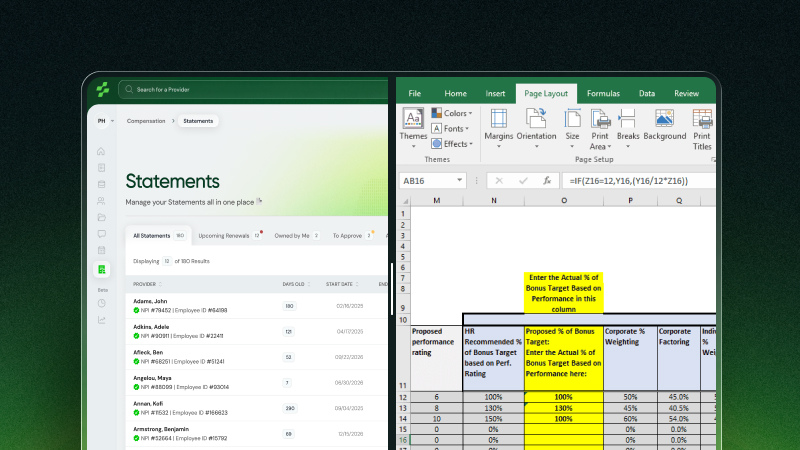
Spreadsheet-based physician compensation can work well when the number of physicians and compensation arrangements is manageable. But as organizations grow, the process often involves more data sources, more variations in contract terms, and more exceptions to account for. Keeping spreadsheets accurate and aligned requires careful coordination across every stage of the compensation cycle.
A missed contract update, a data-entry mistake, or a discrepancy that goes unresolved can affect calculations downstream. And when information passes between files and people, it can become difficult to trace how a number was calculated, who reviewed it, and whether the final payment matches what the physician earned. These vulnerabilities become harder to manage as the process grows more complex.
Where spreadsheet-based compensation processes break down
Physician compensation is a recurring cycle, and each stage depends on the one before it. A spreadsheet may handle an individual calculation well enough. The process tends to break at the handoffs, as files pass between people and results carry from one period into the next.
Bringing compensation inputs together
Before anything is calculated, the compensation team has to gather production data from the EMR, payroll data, time and scheduling records, quality results, and any adjustments. The team then has to make sure each input is associated with the right physician and compensation period. In a spreadsheet process, that usually means a series of exports, manual entry, and re-keying into a master workbook.


Some of that data also arrives secondhand, in files from other teams that each come formatted a little differently and need reshaping before they can be used.


Gathering and organizing these inputs can be labor-intensive, particularly when teams have to pull data from multiple systems, transfer it into spreadsheets, and check that everything is complete and accurate. Errors can enter the process before any calculations begin, and responsibility for resolving data issues may be unclear. When inputs aren’t systematically checked for missing information or mismatches, problems can carry into the calculations and affect the final compensation amount.
Applying approved compensation terms
Once the inputs are in place, the team has to apply the correct model for each physician: the right rates, tiers, thresholds, guarantees, and effective dates. That information starts in the physician’s contract, but in many organizations the signed agreement and its amendments live in one place while the calculation workbook lives in another.
When a rate changes mid-period or an amendment arrives after the month’s file was built, someone has to catch it and update the right version of the right workbook. Outdated terms and conflicting copies are a common source of incorrect calculations, and they can persist for several cycles before anyone traces the issue back to its source.


Connecting contract terms and amendments with compensation workflows can help teams carry approved changes into compensation calculations with minimal manual effort.
Calculating and reviewing earnings
With inputs and terms assembled, the team calculates earnings and reviews the results. Compensation workbooks can accumulate layers of formulas, physician-specific calculations, and manual adjustments over time. As Michele Mays, Physician Compensation Director at MaineHealth, describes it, the process can involve “hundreds of Excel spreadsheets,” with tabs organized by doctor or specialty and manual calculations connecting data inputs to outputs.
As the logic becomes more complex, it becomes harder to review calculations and explain individual results, especially when the process depends on knowledge held by the person who built the workbook.
Any compensation team working out of spreadsheets has to account for the risk of manual errors as they maintain complex workbooks and move data between files. Besides accurate calculations, physicians also look to comp teams to understand how they arrived at those amounts. When the underlying logic is difficult to trace, even a correct calculation can be hard to explain.


Reconciling earnings, payments, and prior balances
Calculating what a physician earned is only half the work. The team also has to compare earned compensation with actual payments, including applicable draws, base pay, and prior incentive payments, and account for balances carried forward from earlier periods. When the figures don’t align, the compensation team has to identify the cause and determine whether an adjustment is needed.
When those records are split across workbooks and payroll exports, reconciliation can become a reconstruction project. Eric Wascome, MD, a hospitalist and physician compensation stakeholder at Franciscan Missionaries of Our Lady Health System, describes a process that once took as much as a week across two or three people and could be completed only once or twice a year. With a connected system, the organization now performs reconciliation monthly with very little additional effort. Results vary by organization, but this example shows how much time can go into assembling and matching information before the team can analyze the results.
Managing exceptions, reviews, and approvals
Every cycle can produce exceptions: a mid-period FTE change, production that hasn’t posted, a disputed credit, or a one-off adjustment. The compensation team must investigate each issue, coordinate with the appropriate stakeholders, and confirm that required reviews and approvals are complete before finalizing results.
In a spreadsheet process, much of that review depends on individual knowledge, and approvals often happen in email threads or hallway conversations. As more people touch the process, it becomes harder to establish who reviewed each item and whether the right information reached the next person.


Without clear accountability for each handoff, errors can go undetected until a physician questions a statement. Documenting who reviewed and approved the results, when approval occurred, and which figures were approved gives the team a clear record to consult when questions arise later.
Producing statements and sending approved results to payroll
Approved compensation calculations support two related outputs: statements that explain physicians’ earnings and payroll information used to process payment. In many spreadsheet-based workflows, teams prepare statements from separate files and assemble payroll information manually from the finalized calculations. Each round of corrections can create another version, making it harder to confirm which figures were approved and which amounts were ultimately sent to payroll.
This work can become particularly labor-intensive at scale. Deaconess Health System eliminated its manual Excel statement process for approximately 500 productivity-compensated physicians after moving that work into a connected system.
Compensation statements should give physicians enough detail to understand how their earnings relate to their production. When figures are difficult to trace back to the underlying calculations, the compensation team may need to revisit the original data and reconstruct the calculation to answer questions.
Feeding actual payment data into the next cycle
The cycle doesn’t end when payroll runs. Actual paid amounts come back from payroll and inform the next reconciliation period. If that payment data arrives late, has to be matched by hand, or isn’t incorporated into the next cycle, discrepancies can carry forward and become harder to resolve. Keeping payment records connected to the compensation process helps teams identify differences between earned and paid amounts before they accumulate across periods.
See how each stage of the cycle connects.
Simpliphy Compensation Management brings model logic, calculation, earned-versus-paid reconciliation, statements, and payroll preparation into one recurring workflow.
Why these breakdowns become more consequential at scale
A problem with one physician’s calculation may be relatively straightforward to investigate and correct. As an organization scales, however, the same types of problems can affect more physicians, compensation arrangements, and handoffs. Each additional physician or model variation adds inputs to collect, terms to apply, results to reconcile, and approvals to track, increasing the coordination required to keep the process consistent.
Complexity and physician count both cause strain
Organizations may assume they need a dedicated compensation system only after reaching a certain size. In practice, the variety of arrangements can matter as much as the number of physicians. Each variation adds complexity to the workbook’s formulas and logic, making the model harder to maintain and verify as arrangements evolve.
Smaller organizations face a different challenge: they often have fewer staff members available to manage that work. Compensation administration can fall heavily on the CFO and sometimes the CEO. When executives have to spend time coordinating files, checking calculations, and resolving discrepancies, they have less capacity for financial planning, performance analysis, and other strategic priorities.
Payment errors affect physicians and financial performance
Errors in physician compensation have consequences beyond correcting a number in a workbook. Overpayments may require the organization to recover funds, creating difficult conversations with physicians. Underpayments can prompt disputes, consume analyst time, and undermine physicians’ confidence that their compensation accurately reflects their work.
When the underlying calculations are difficult to trace, resolving either problem becomes more complicated. The compensation team may need to revisit source data, determine which terms applied, and reconstruct how the final amount was calculated before it can explain the discrepancy. Even when the team resolves an individual issue, repeated disputes can strain the relationship between physicians and the organization.
Persistent frustration can also contribute to physician turnover, adding a broader financial consideration. The American Medical Association estimates that replacing a physician often costs a practice two to three times the physician’s annual salary. Departures can affect revenue as well, particularly when patients follow their physician to another practice.
Learn more: Supporting Physicians: An Operational Perspective
Accountability gets harder to establish
As compensation processes involve more files, people, and handoffs, explaining how a payment was calculated can become increasingly difficult. Teams need to be able to establish which compensation terms applied during a given period, what data informed the result, who reviewed and approved it, and whether any changes occurred before payment.
This documentation supports finance and compliance reviews of physician arrangements, including fair market value and commercial reasonableness. It also helps preserve institutional knowledge. When calculation logic exists primarily in an individual analyst’s workbooks, colleagues may struggle to maintain the process or explain historical payments if that person leaves.
Learn more: Recognizing When Manual Compensation Processes Reach Their Operational Limits
What a connected compensation workflow changes
A connected compensation workflow brings the recurring steps of physician compensation into a coordinated process. Instead of repeatedly gathering information from separate files and rebuilding the context for each calculation, the team can work from organized source data, applicable compensation terms, and a consistent record of calculations, reviews, and payments.
Several changes make that possible:
- Source data and compensation terms stay connected. Each physician’s active model and effective terms sit alongside production, payroll, quality, time, adjustments, payments, and balances, so the calculation draws on one shared context instead of several files.
- Repeatable calculations and reconciliation follow a consistent process. The correct compensation logic is applied each cycle, and earned compensation can be compared with actual payments and balances carried forward. This reduces the need to reconstruct the calculation across multiple workbooks.
- Reviews, exceptions, and approvals are easier to track. Validation checks and pay variance views can help the team identify issues that need investigation. Recorded reviews and approvals also provide a clearer history of how results were finalized.
- Statements and payroll handoffs draw on approved results. The team can prepare physician statements and payroll information from the finalized compensation calculations, reducing duplicate entry and the risk of inconsistencies between separate files.
- Payment information informs the next cycle. Actual amounts paid can be matched against compensation records and used to update balances, helping the team identify differences before they become more difficult to resolve over time.
The table below shows how these changes affect each stage of the compensation cycle.
| Cycle stage | Spreadsheet-based process | Connected workflow |
| Bringing inputs together | Exports, re-keying, and files received from other teams | Relevant source data organized by physician and compensation period, with validation |
| Applying approved terms | Contract terms and amendments manually reflected in workbooks | Compensation models and applicable terms maintained within the workflow |
| Calculating and reviewing | Formulas and physician-specific calculations spread across workbooks | Applicable model logic applied consistently, with supporting calculation detail |
| Reconciling | Earnings, payments, and balances reconstructed across files | Earned amounts, actual payments, and outstanding balances tracked together |
| Exceptions and approvals | Reviews coordinated through email and individual knowledge | Issues surfaced for review, with approvals recorded |
| Statements and payroll | Statements assembled individually and payroll information prepared manually | Statements and payroll information prepared from approved calculations, with easy batch export |
| Next cycle | Paid amounts manually matched back to compensation records | Actual payment information carried forward to inform the next period |
Manage the compensation cycle with Simpliphy
Simpliphy’s physician compensation platform connects compensation models with the data, calculations, reconciliation, and workflows needed to manage each compensation cycle. It applies the terms associated with each compensation arrangement, supports earned-versus-paid reconciliation, records statement approvals, and prepares payroll information for the handoff. Actual payment data can then inform the next cycle, and physicians can use the Simpliphy Mobile App to review their production, earnings, and payments.
By bringing these steps into a connected process, Simpliphy helps compensation teams reduce manual coordination and spend more time reviewing results, analyzing discrepancies, and answering physicians’ questions. The platform also makes supporting information available to help teams investigate issues and explain how compensation amounts were calculated.
Organizations also don’t need custom software to keep the compensation models they have. Simpliphy maintains a large library of templated compensation plans built from cross-client experience, helping organizations accommodate their existing compensation structures without building a system from scratch.
If you’re considering a move away from spreadsheets, Simpliphy can help your organization bring the full compensation cycle into a more connected, manageable process. Request a demo to walk through your compensation workflow with Simpliphy.
You may also like:

The Simpliphy Team combines experience in physician compensation, healthcare finance, operations, and technology to help health systems navigate one of their most complex administrative functions. Through practical insights and firsthand experience, our team shares perspectives that help organizations simplify compensation, improve transparency, and make more informed decisions.

Danny McNight is Director of Marketing at Simpliphy, leading the development of campaigns and brand experiences that make complex ideas clear and compelling. With a background in digital creative direction, he helps shape how Simpliphy communicates its value across channels and audiences.