

Productivity Without Mandates: Why Compensation Clarity Changes Physician Behavior

The Problem: Why Productivity Mandates Miss the Mark
Healthcare organizations have invested heavily in improving provider productivity. Measurement and reporting are more sophisticated than ever. Yet resistance to productivity initiatives persists.
That resistance is often misunderstood. Physicians do not object to productivity or to being measured. What they resist is how these efforts are experienced: surveillance rather than support, organizational pressure rather than usable insight, and judgment delivered after clinical decisions are already made.
At the same time, many physicians lack clear visibility into how their clinical work translates into compensation. Production and earnings information is often delayed, opaque, and difficult to apply in real time.
The tension between resisting being managed and wanting to be informed is the gap Simpliphy was designed to address.
Physicians analyzed
Across 8 health systems
Average daily wRVU increase
among engaged physicians
Additional annual wRVUs
per engaged physician
The Solution: How Compensation Clarity Changes the Frame
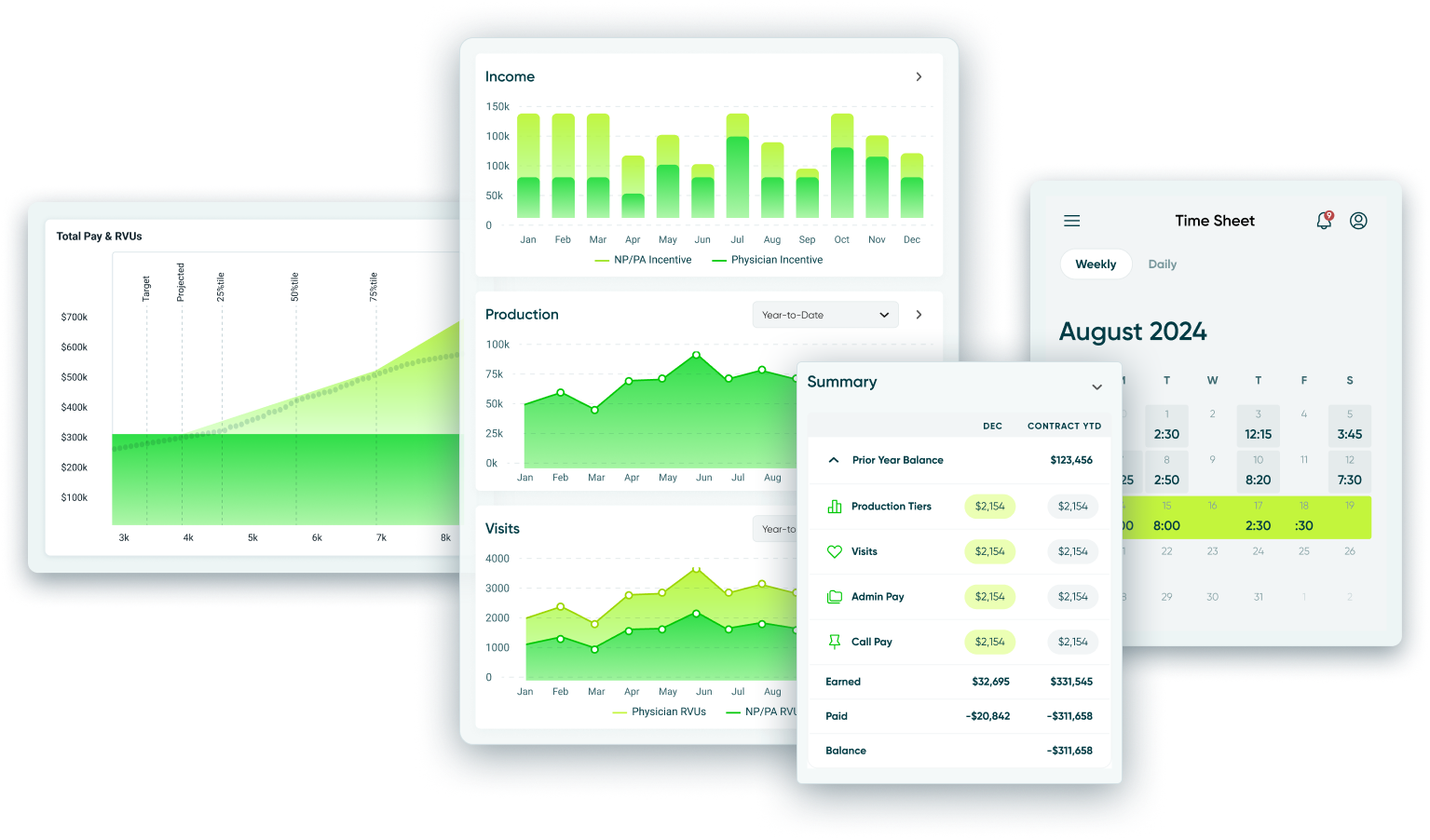
Rather than framing productivity as a top-down directive, Simpliphy gives physicians ongoing visibility into how clinical work translates into production and earnings.
It does so through a unified desktop and mobile experience designed around real clinical workflows. From the physician’s perspective, this information is not scattered across disconnected tools or buried in spreadsheets.
Simpliphy makes the full physician compensation picture usable by bringing production, earnings, and related compensation workflows into focus within a single provider experience that physicians can access throughout the year.
Inside the platform, physicians can see production, earnings, and progress throughout the year as current, usable information rather than static reports. Compensation logic that is often difficult to follow becomes easier to understand in practice.
This clarity does not prescribe behavior. It restores agency.
When this clarity is present, the frame shifts. Productivity no longer feels like an external demand. Compensation becomes something physicians can understand and monitor in relation to their own goals.
Some physicians use the information to confirm their current pace. Others make intentional adjustments once effort and earnings are clear. Some, often already high performers, see opportunity more clearly and act on it.
Across an organization, those individual decisions can begin to align more naturally with broader productivity goals without mandates or enforcement.
Review our complete observational analysis of 1,258 providers across eight health systems.
The Outcome: How Compensation Clarity Relates to Productivity
An observational analysis examined productivity outcomes among 1,258 providers across eight health systems following initial engagement with the Simpliphy platform through the Desktop or Mobile App.
To account for broader system-wide productivity movement unrelated to platform use, providers with minimal interaction were used as a reference baseline. Productivity differences among more engaged providers were evaluated relative to this group.
Industry benchmarking during the study period suggests modest productivity growth across health systems in the low single digits year over year. The baseline productivity movement observed in this dataset was broadly consistent with those trends.
Providers with moderate engagement demonstrated an average incremental increase of approximately +0.41 daily wRVUs relative to the baseline.
Providers with the highest engagement demonstrated an average incremental increase of approximately +1.57 daily wRVUs.
Across engaged groups, roughly 62 to 69 percent of providers experienced productivity improvement.
These findings do not suggest mandates or guarantees. They describe observed relationships only.
They point to a consistent pattern: when physicians choose to engage with Simpliphy, productivity improvement is more commonly observed, and deeper engagement is associated with stronger outcomes. Importantly, that engagement is voluntary.
There are no quotas, enforced workflows, or required behaviors. The platform provides clarity, and physicians decide how to respond based on their own goals and priorities.
The Impact: What Modest Differences Look Like at Scale
The observed engaged-group average was approximately +0.99 daily wRVUs relative to the Minimal Engagement baseline.
Across roughly 230 working days, that difference equates to about 228 to 230 additional annual wRVUs per engaged physician.
To illustrate the scale, consider a 500-physician organization where roughly one-third of physicians actively engage with Simpliphy. That level of engagement represents about 165 physicians. At the observed engaged-group average, that population would generate roughly 37,000 to 38,000 additional annual wRVUs.
Simpliphy Mobile App Dashboard Views
Clinical Time: Frictionless Access with the Mobile App
Clarity only works if it arrives in clinical time.
Physicians rarely have long analytical windows during the day. Instead, they work within brief moments between patients, after clinic, or during natural pauses in the schedule. If insight arrives weeks later in a report, it is often too late to influence behavior.
That is where the Simpliphy mobile app matters. It gives physicians access to a live balance of income and production, along with their procedure calendar, time tracking, forecasting, and performance, in the moments when they can actually use that information.
By making those signals available in the flow of the clinical day, the mobile app turns compensation visibility into something immediate rather than retrospective. Progress becomes visible earlier, and decisions feel informed rather than reactive.
A Different Way to Think About Productivity
The broader insight from this analysis is not that productivity can be forced. It is that productivity often improves when physicians have clear, usable visibility through Simpliphy into how their work translates into compensation.
When that connection becomes clear, behavior can change without mandates.
Physicians gain the ability to understand where they stand and make decisions accordingly.
Across a population of providers, those individual decisions can align more closely with organizational goals. The result is a form of productivity improvement grounded less in control and more in transparency, trust, and informed choice.

Chris Carson is a Senior Advisor at Simpliphy with more than 30 years of experience advising health systems, medical groups, and healthcare technology organizations. His clients include University of Michigan Health, Northern Arizona Health, Northern Light, Boston Medical Center, Geisinger Health, Sutter Health, Children's National, and Howard University, with expertise in physician compensation, medical group strategy, and ambulatory healthcare consulting.

Danny McNight is Director of Marketing at Simpliphy, leading the development of campaigns and brand experiences that make complex ideas clear and compelling. With a background in digital creative direction, he helps shape how Simpliphy communicates its value across channels and audiences.
The information in this article is for general informational purposes only and does not constitute legal, tax, financial, or compliance advice. Physician compensation arrangements, including fair market value determinations, are fact-specific and regulated under laws such as Stark and the Anti-Kickback Statute; consult a qualified attorney or valuation professional before relying on this information. This article reflects information current as of its publication date and may not account for subsequent changes in law, regulation, or industry practice.